


The Proof Is in the Peanut!
This new research reinforces what we already know about the efficacy of early introduction and underscores a critical step to reduce the incidence and prevalence of peanut allergy nationwide.
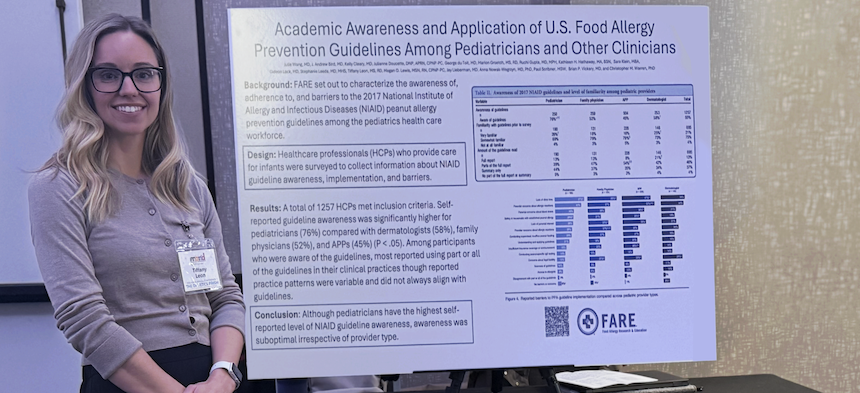
Guest post by Tiffany Leon, MS, RD, Assistant Director of Training and Professional Programs at FARE
It’s working! Researchers at the Children’s Hospital of Philadelphia (CHOP) have analyzed data that shows decreased rates of developing peanut allergy in the period following the advisement toward early introduction of infant-safe form of peanut during infancy beginning at about 4-6 months of age. This is real-world data demonstrating in the U.S. what was learned from the landmark Learning Early About Peanut Allergy (LEAP) study in 2015, which, based on its findings, reversed guidance to avoid peanuts early in life to advise intentional, regular consumption as a strategy to prevent developing peanut allergy.
Since 2017, the National Institute of Allergy and Infectious Diseases (NIAID), U.S. Departments of Agriculture (USDA) and Health and Human Services (HHS), as well as the American Academy of Pediatrics (AAP), have issued infant feeding guidelines to support the findings from the LEAP study. Meaning, early and regular consumption of infant-safe forms of peanut containing foods is proven to reduce the risk of developing peanut allergy during infancy by over 80%. The North American professional allergy organizations agree and in 2021, a consensus statement was released from the American Academy of Allergy, Asthma, and Immunology (AAAAI); American College of Allergy, Asthma, and Immunology (ACAAI); and the Canadian Society for Allergy and Clinical Immunology (CSACI).
Even after a decade since the LEAP study findings were published, there remains much work to be done. A FARE-led study published in 2024 showed that only 76% of surveyed pediatricians and 52% of family physicians were aware of the 2017 NIAID guidelines that recommend early introduction of peanut to prevent food allergy. Among those, implementation of revised guidelines was “‘variable,” highlighting that education for new parents and healthcare professionals is critical. There is a long runway from release of guidelines up to achieving full and complete implementation.
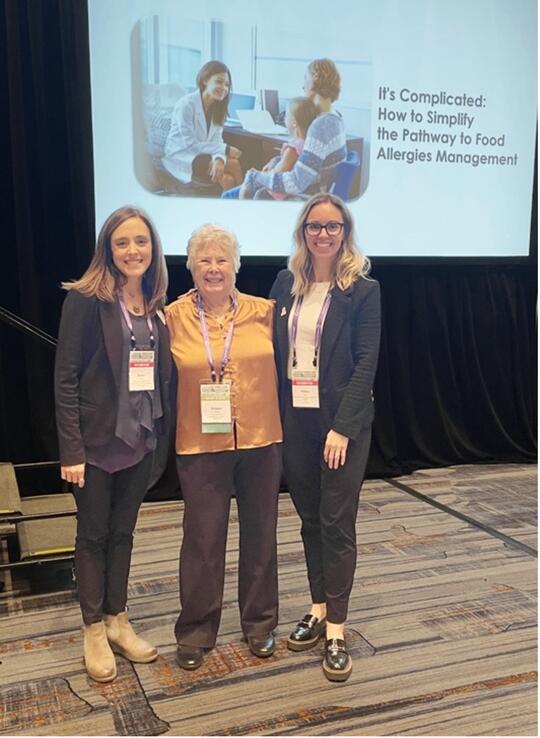
Photo (Shown R-L): Tiffany Leon, MS, RD, presented on food allergy prevention strategies alongside Susan Krahn, MS, RDN, CD, CLC, and Colleen Pierre, MS, RDN, LDN, at the 2024 National WIC Association Nutrition and Breastfeeding Conference.
Where do we go from here?
This recent research reinforces what we already know and underscores a critical step to reduce the incidence and prevalence of peanut allergy nationwide.
From a policy perspective, the CHOP study highlights the critical need to expand simple, scalable actions such as the USDA including infant-safe peanut products in the infant food packages for families receiving WIC Program (Special Supplemental Nutrition Program for Women, Infants, and Children) benefits to drive real public health change, since almost half of infants born in the U.S. are eligible to receive WIC benefits. Policy changes such as this can elevate the positive outcome of early introduction from 27.2% to get to the over 80% reduction shown in the 2015 LEAP study. Thousands of families receive monthly WIC benefits, and inclusion of infant-safe peanut products in infant WIC food packages would have an extremely positive impact on peanut allergy reduction. In addition, the State of Delaware passed a landmark law in August 2024 that requires all public and private health insurers (fee for service and Medicaid) to provide infant-safe peanut and egg products to all infants for early introduction, beginning in January 2026.
Expecting and new parents must be informed, and pediatricians and other health professionals need to know that early introduction is a key to prevention and a universally recommended practice. FARE will continue to raise awareness of these strategies through our work with key partners like the National Peanut Board. We say, “Eat Early, Eat Often.” Earlier this year, FARE hosted a Food Allergy Academy webinar with Dr. Carina Venter with over 1,300 registrants and published an educational module for registered dietitians on the Academy of Nutrition and Dietetics continuing education website.
To turn the tide on peanut allergy and food allergy in general, we must prioritize prevention while accelerating research toward additional treatments and a cure—ensuring that every child has the chance to grow up free from the burden of food allergy.